

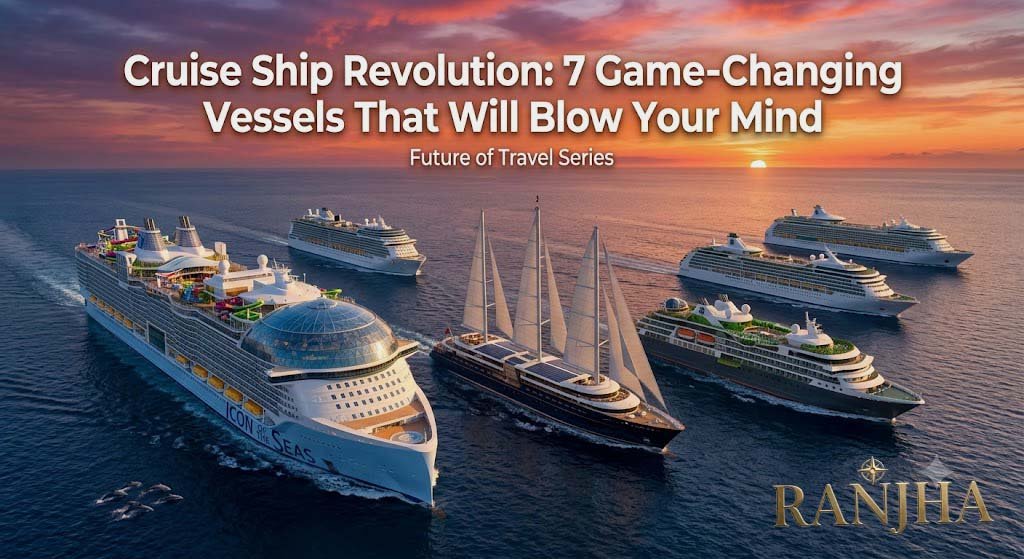
The Next Generation Cruise Ship
Introduction
For decades, the cruise industry followed a predictable formula: build bigger ships with more cabins, more restaurants, and more entertainment. But the next generation of cruise ships represents a fundamental shift in thinking. Today’s shipbuilders are tackling three ambitious goals simultaneously—achieving unprecedented size, dramatically reducing environmental impact, and transforming the onboard experience into something that feels less like a floating hotel and more like a self-contained city.
From fully electric vessels that eliminate local emissions to megaliners that rival the length of entire city blocks, the future of cruising is arriving faster than most people realise.
The Megaship Revolution: Icon Class Dominance
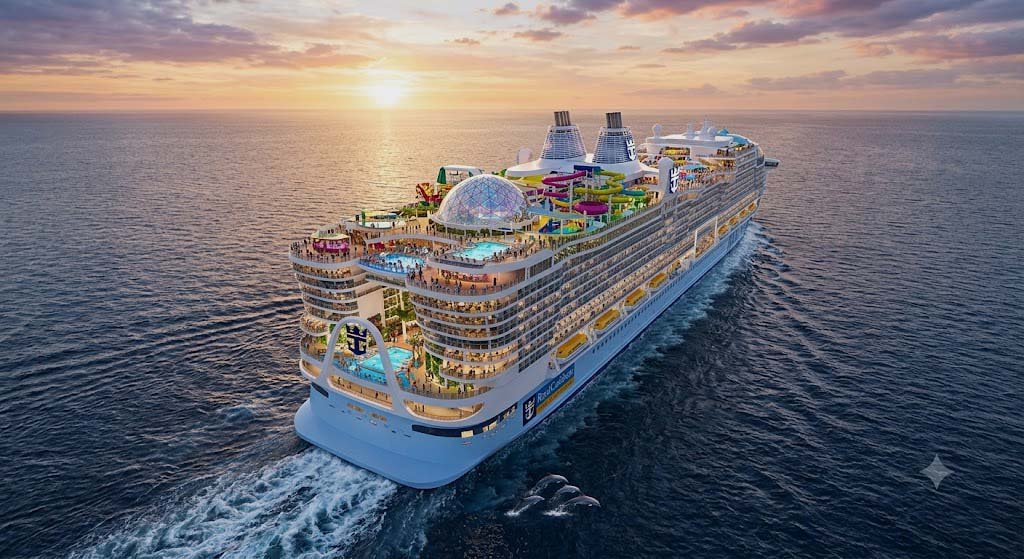
Royal Caribbean’s Icon Class has redefined what a cruise ship can be. The first vessel, Icon of the Seas, debuted in 2024 at a staggering 250,800 gross tons, accommodating up to 7,600 passengers across 20 decks . Its successor, Star of the Seas, launched in August 2025, featuring the same massive scale with 5,610 guest capacity and 2,805 staterooms .
The class expansion is aggressive. Legend of the Seas entered service in July 2026 as the third Icon vessel, now holding the title of the world’s largest cruise ship . Hero of the Seas follows in 2027, with Icon 5, Icon 6, and Icon 7 scheduled through 2030 . Each ship spans 365 metres in length—longer than three football fields—and features 18 passenger decks arranged around eight distinct “neighbourhoods” .
What makes these ships truly next-generation is not just their scale but their design philosophy. Rather than feeling overwhelming, the Icon Class uses 22 destination elevators and clever neighbourhood zoning to help passengers move easily between areas . Central Park features more than 33,000 living plants, while the Category 6 waterpark includes six corkscrew slides .
Sustainability Takes Centre Stage
Environmental innovation is arguably the defining characteristic of next-generation ships. The Icon Class vessels are powered by LNG (Liquefied Natural Gas) with fuel cell technology and shore-power connections that enable virtually emission-free operations while berthed—approximately 40% of their operational time .
TUI Cruises’ “Mein Schiff Flow,” delivered in July 2026, represents another leap forward. This 160,000-gross-ton vessel uses dual-fuel LNG and MGO propulsion, with Euro 6-compliant catalytic converters and a steam turbine that recovers residual heat from diesel generators . The ship also features an innovative waste treatment system that transforms organic materials into recyclable components through thermal processing .
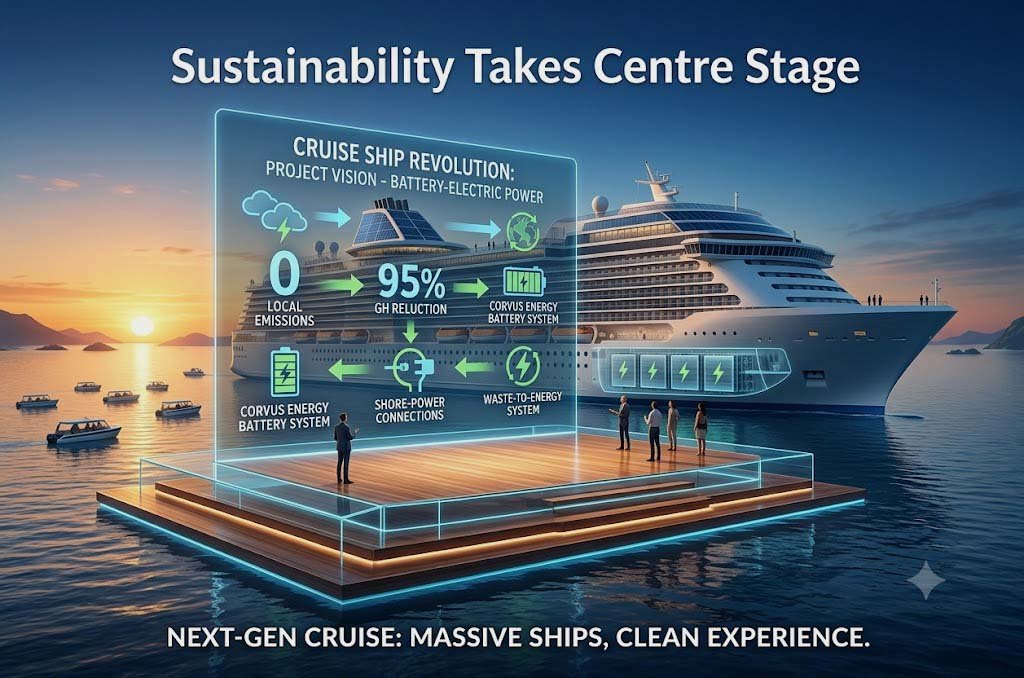
But the most ambitious sustainability project comes from German shipbuilder Meyer Werft, which unveiled “Project Vision” at Seatrade Cruise Global in 2026—a 100% battery-electric cruise ship concept . The 82,000-gross-ton vessel, 275 metres long, would carry 1,856 passengers with no local emissions and up to 95% reduction in greenhouse gases .
The battery system, developed by Corvus Energy, uses technology already powering hundreds of electric ferries . “Batteries are now in a state with the energy density and other aspects, safety, life cycle and so on, where we say, now this is the most energy efficient way to do cruises,” explained project engineer Johannes Bade . If ordered this year, the first ship could deliver by 2031 .
Conclusion
While Royal Caribbean dominates the megaship space, other operators are pursuing different visions of the future. MSC Cruises is launching MSC World Asia in 2026, a World Class vessel with Asian-inspired design sailing from Barcelona . Norwegian Cruise Line introduced Norwegian Luna, a 156,000-gross-ton Prima Plus Class ship featuring the Aqua Slidecoaster—a hybrid waterslide and rollercoaster—and 17 dining venues .
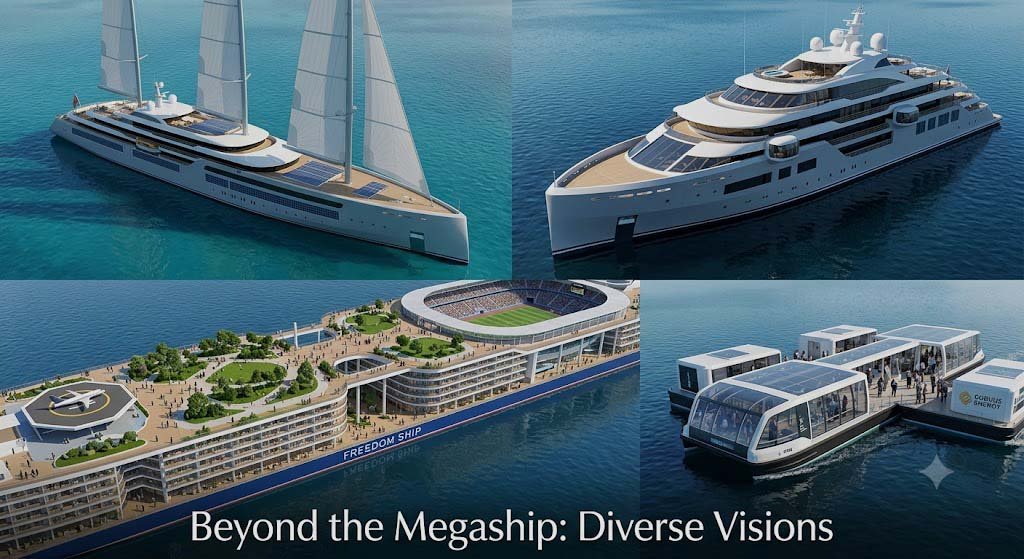
Perhaps the most unexpected innovation is the Orient Express Corinthian, delivered in April 2026 as the world’s largest sailing cruise ship . At 220 metres with three rigid sails totalling 4,500 square metres, it combines large-scale wind propulsion with luxury hospitality—proving that next-generation doesn’t always mean engine-powered.
Meanwhile, the Freedom Ship concept pushes scale to its logical extreme: a mile-long floating city weighing over 2 million gross tons, housing 80,000 people with its own hospital, schools, and 15,000-seat stadium . While still a proposal, it represents the outer boundary of maritime ambition.
Conclusion
The next generation of cruise ships is defined by three converging trends: unprecedented scale, serious environmental commitment, and experience-driven design. The Icon Class has shown that megaships can be thoughtfully designed rather than overwhelming, while Project Vision proves that zero-emission cruising is technically feasible today. The industry’s future lies in blending these innovations—massive ships that are also clean, and experiences that feel personal despite their scale. As one industry leader put it, the goal is a “mosaic or bundle of solutions” working together .
About the Author
My name is Dua Qamar, and I am a content writer passionate about maritime innovation, sustainable travel, and the future of the cruise industry.
Why I Wrote This Article:
I wrote this piece because the cruise industry is undergoing its most significant transformation in decades. The ships launching today are not just larger versions of their predecessors—they represent entirely new approaches to design, energy, and passenger experience. I wanted to capture this moment of change and explain what it means for travellers and the environment.
How I Approached This Topic:
My research involved examining multiple industry sources, including shipbuilder announcements and delivery reports from Fincantieri and Meyer Turku, to provide a comprehensive picture of the next-generation cruise landscape.
Who This Article Is For:
This article is for cruise enthusiasts, eco-conscious travellers, and anyone curious about how technology and sustainability are reshaping one of the world’s most popular vacation industries.
The Message I Hope Readers Take Away:
The future of cruising is not just about bigger ships—it is about smarter, cleaner, and more immersive experiences that respect both passengers and the planet.
Written by: Dua Qamar
